Meeting a new medium
I've started to experiment with air-dry clay. I've never worked with this medium before, so I'm starting to play around. My first art teacher taught me that playing around IS art-making, and an essential start to any art piece. And my friend and mentor Mimi Ito has written a book about the importance of "messing around" in learning digital media. So I started making a basic shape -- a sphere. Then I tried rolling small cylinders. My fingers and hands are starting to learn how to work the material. It requires frequent moistening or it cracks, and cracks need to be smoothed with water. I had no idea of what I was making...other than small spheres and cylinders.
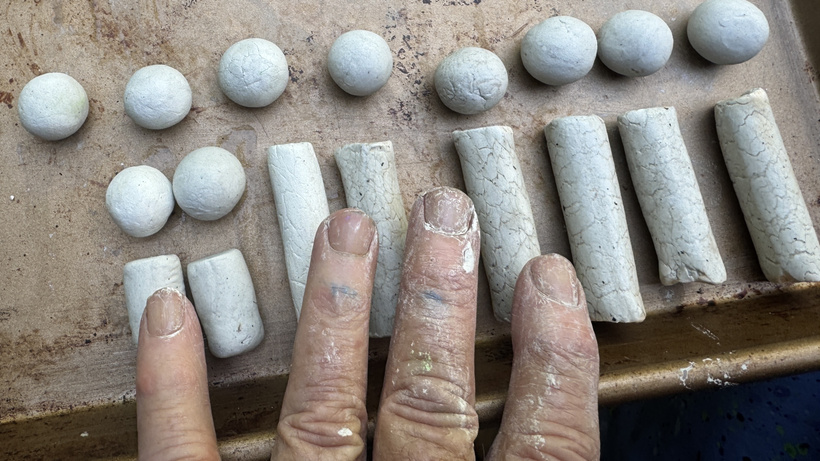
Notice how the cylinders have a crackly surface. It wasn't an easy fix. I eventually learned a combination of moisture, pressure, and movement. I decided to paint them. And to glue them to a sphere. The big blob of clay didn't end of spherical and it took several days to dry. I thought it would hasten drying by leaving it out in the sun, but that cracked my first attempts. As usual, I plunged in to practice without reading the manual. It turns out that this clay likes to take its time drying,
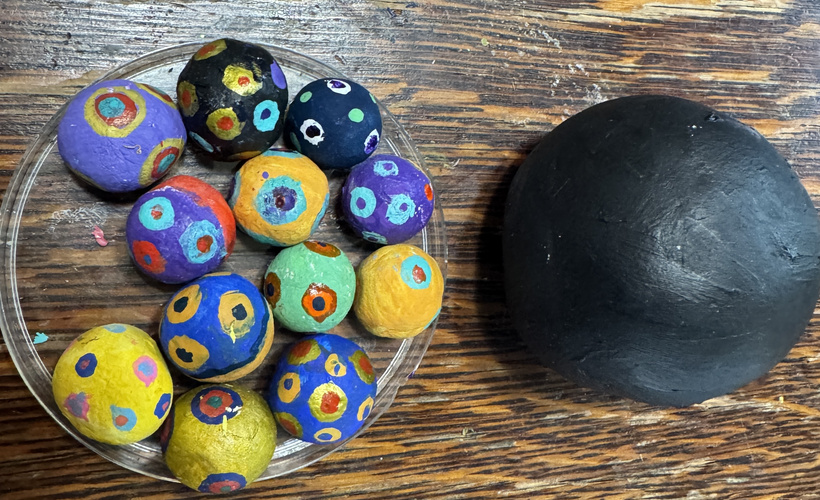
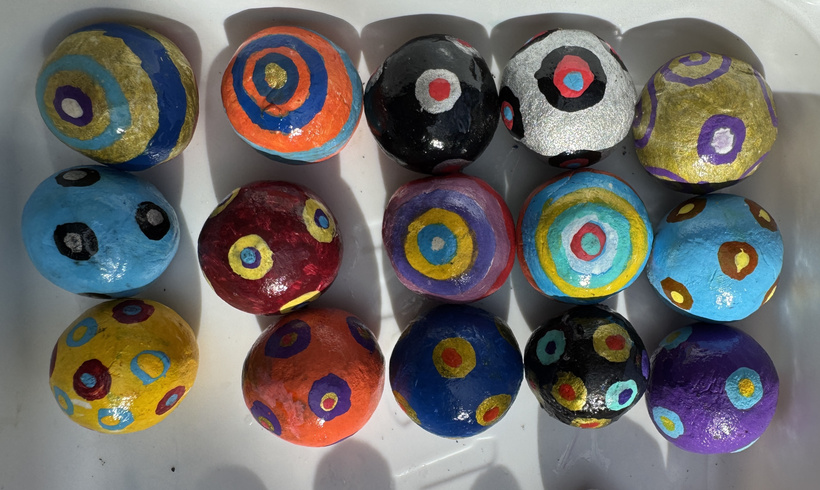
I painted the spheres with acrylic pens, with the intention of eventually gluing them to the sphere.
Trying to hold and paint the little spheres is a pain, so I started making larger ones.
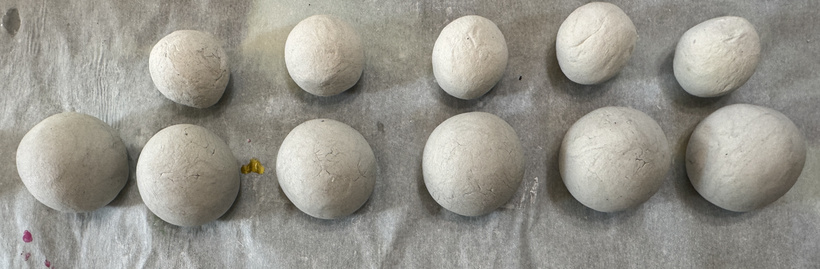
The large ones turn out to be easier to paint.
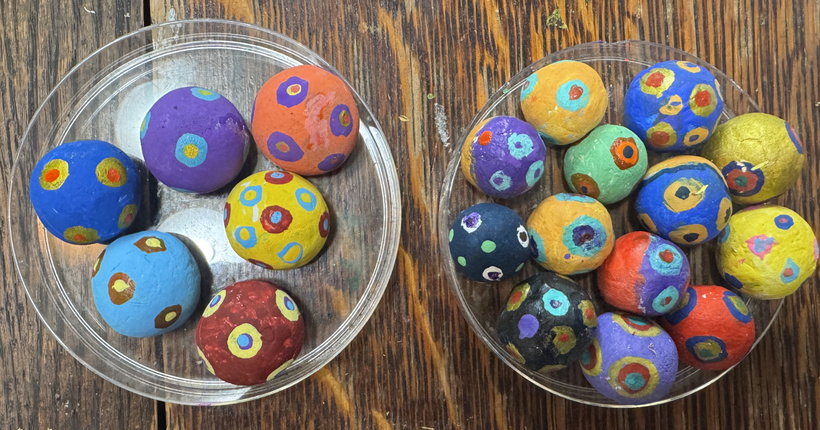
Since I dotted the spheres, I decided to stripe the cylinders.
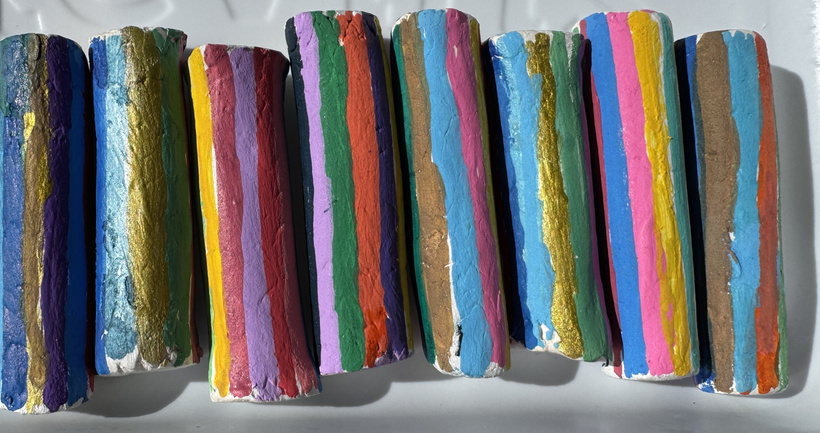
Next step is to apply a glossy varnish to spheres and cylinders. Again, I'm not striving for perfection -- I'm playing with the material, learning how to work it. If I was confident of my mastery of the material, the cylinders and painting would be more uniform looking. Learning is not about perfection, but about pushing the medium to understand and internalize the affordances, pitfalls, capabilities, failure modes of the medium -- to the point that my eyes and fingers know how to achieve the ends I seek. But for now, end-seeking is not the point.
Next, I started gluing the cylinders and spheres together.
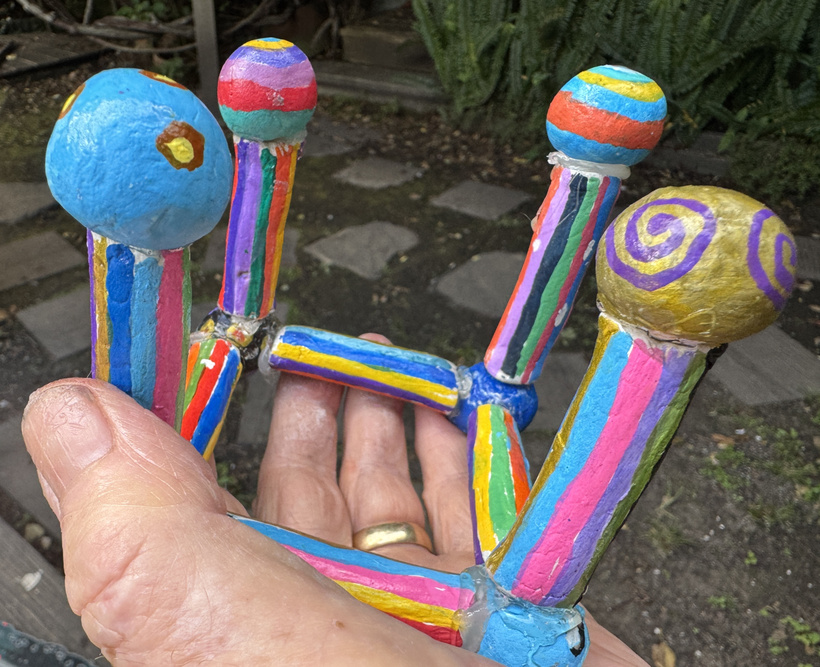
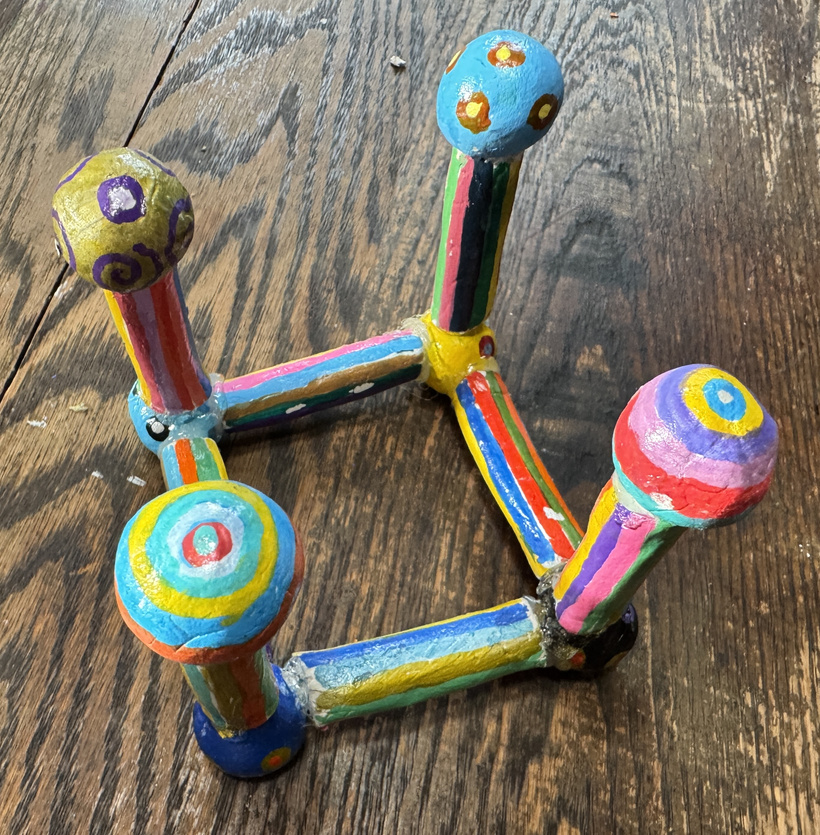
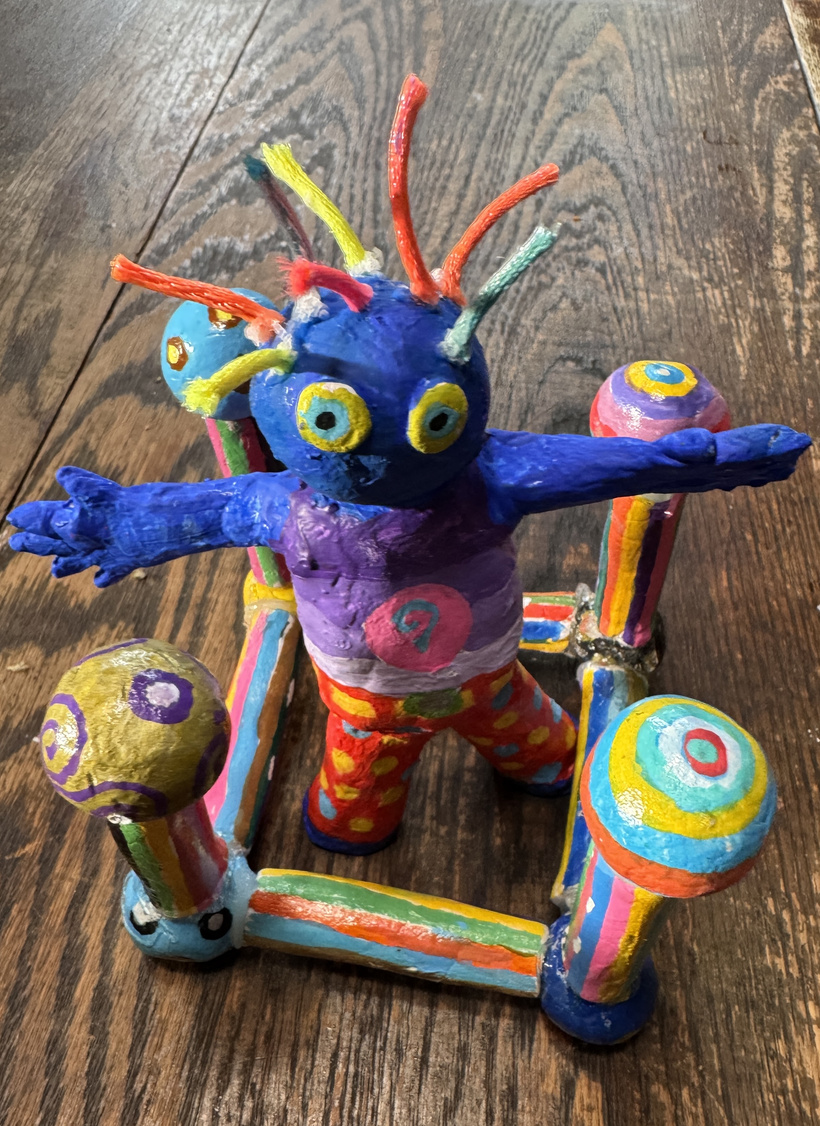
Not long after the last photo, I picked up the structure and it fell apart. I started with e3000 glue. It didn't hold at all. So I switched to hot glue. Hot glue is always messy, but it dries fast. But it didn't hold. So I switched to cyanoacrylate glue that I use for turning wooden pens. I like it because a spray catalyst hardens it instantly -- an advantage over acrylic. CA glue holds. But all the changing of glues ended up flaking paint off the spheres and cylinders and the whole thing is crooked in multiple dimensions.
So I need to start over: I will make larger spheres and cylinders, and flatten most of the spheres on two sides, since they will be glued to cylinders. I will leave the flattened parts unpainted and unglazed. I'll put the CA glue on one of the flat parts of a sphere and the catalyst on the end of a cylinder and carefully mash them together. I also learned some things about the difficulty of holding even the larger spheres in my fingers while attempting to paint, so the first thing I will do is mold a piece of clay into a kind of stand to hold spheres while I am painting them. And I plan to paint thicker, straighter, more uniform stripes on the cylinders
I will take the rickety sculpture apart, repaint parts if necessary, and put the parts out in my little free art gallery.