Balinese Religio-ecology
Originally published for paying Patreon members on 2026-06-13. Republished here after a 90-day patron-first period.
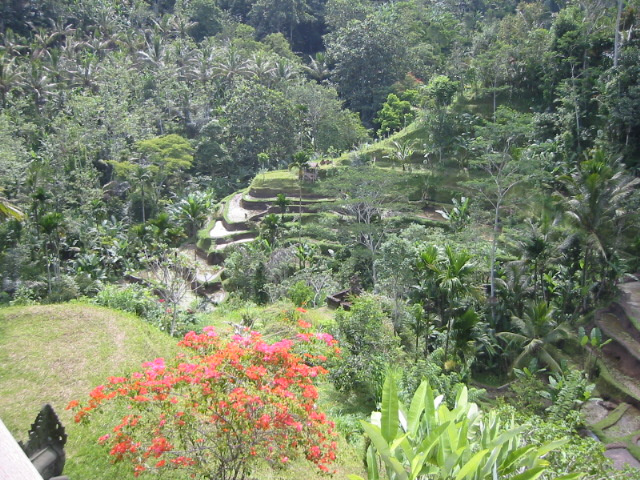
A sketch from my pocket notebook I made during my weeks in Bali twenty years ago. I was deep into my exploration of cooperation theory and I had come across Perfect Order, a book about a multisciplinary study of Bali's complex network of water temples and irrigation canals hewn into the islands volcanic rock:
Along rivers in Bali, small groups of farmers meet regularly in water temples to manage their irrigation systems. They have done so for a thousand years. Over the centuries, water temple networks have expanded to manage the ecology of rice terraces at the scale of whole watersheds. Although each group focuses on its own problems, a global solution nonetheless emerges that optimizes irrigation flows for everyone. Did someone have to design Bali’s water temple networks, or could they have emerged from a self-organizing process?
The study was precipitated by an experiment and a disaster. In the 1950s, agronomists, enthused by the ongoing "green revolution" of high-yield varieties of rice and fertilizer-fueled year-round harvests, introduced new agricultural techniques to Bali's rice paddies. The result was a record harvest followed by a near-total collapse of the agricultural system triggered by populations of vermin. It turned out that the Balinese water temple system, ostensibly a religious ritual, was an effective barrier against just such a collapse: the temple meetings coordinated flooding of adjacent fields; if a farmer floods a field but neighbors don't, vermin just move to dry ground then return. The fertilizer also started running into the sea and poisoning fishing grounds.
In addition to vermin-control, the system enabled equitable water-sharing. Water sharing is a classic cooperation problem. There is no incentive for upstream water users to cooperate with downstream users. In Southern California, water-sharing was finally settled after decades of contention through lawsuits. In Spain, a system similar to Bali's originated during the Moorish occupation and continues to this day.
How was Bali's religious-eco system created? Was it designed? Or did it emerge? Lansing and anthropologists, archaeologists, ecologists, agronomists, and others uncovered a system that emerged over centuries.
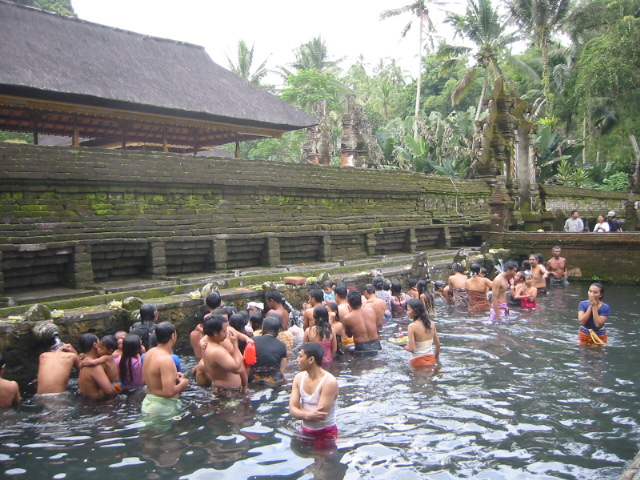
During my time in Bali, I visited the water temples. Hardly solemn places, the temples are the scene of bathing and fun.
The sketch I made was of the ravine next to Murni's Warung, where I often dined. Murni later visited us in San Francisco.