Thinking about thinking about thinking
(The image at the top of this post depicts my mindmap about thinking. The clickable mindmap can be found here.)
I've been thinking about thinking for a while. It grew out of my interest in attention to attention when I was teaching college students. I called the skill my (mostly millennial) students needed in the age of online distraction "infotention." The exercise I suggested -- writing down their goals for the day and putting the note in the corner of their laptop or desktop computer screen, then asking themselves where they were in their planned day whenever their gaze encountered the note -- was also an exercise in examining their own thinking, or metacognition, which I have written about here a number of times.
Most recently, because my 5 year old grandson is growing up in the age of LLMs, which provide a cornucopia of knowledge, some of which is inaccurate, wrong, or outright lies, I've been looking into literature regarding research into teaching metacognition -- which recent research literature suggests is one way to immunize young people to the decline in thinking ability that appears to be a result of undisciplined cognitive offloading -- the tendency to delegate mental work to external systems. It's not just the need for crap detection, it's the need for a structured approach to LLM use to avoid a decline in thinking abilities.
I'm not the first only educator who is thinking about thinking as a pedagogical vaccine against erosive cognitive offloading. Knowing of my interest in this topic, a friend sent me a link to this post by Rafe Steinhauer on two specific classroom exercises for strengthening metacognition skills: "journey mapping" and "Janusian thinking."
In education, metacognition refers to intentional activities that increase students’ awareness of—and participation in—how their learning occurs, and it’s as close to an unalloyed propellant for learning as exercise is for health and well-being.
Steinhauer is speaking to secondary and higher education teachers, and I plan to follow this new pedagogy. I alsowill continue to focus as well on 5 year olds, the age at which I intuitively suspect it will be necessary to start if future generations are to resist handing their thinking skills over to machines.
I'm one of many who feel that human civilization is at a pivotal point, one perhaps more consequential than previous mind-media co-evolutionary transitions. If I live another five years, I may well be able to see the narrow range of possible outcomes, a foresight exercise that isn't possible beyond wild speculation right now. But one thing that is easy to predict is that AI development is moving quickly. Because so much uninformed and misinformed opinion is flying around right now, I feel it is particularly important to draw inferences from peer-reviewed research literature, and to refer to that literature to test intuitions.
What does the literature say about cognitive offloading and its effects on learning? A few examples:
The Homogenizing Effect of Large Language Models on Human Expression and Thought
LLMs can amplify short‑term accuracy and task performance, but perhaps at the cost of standardizing thinking, narrow ingcreative and cognitive diversity, and encouraging increasing reliance on machine intelligence over human reasoning. Consequences could include hampering the ability to sustain collective knowledge creation and verification over the long run as well as degrading how humans think, create, and innovate.
Multiple analyses and working papers highlight that, while LLMs free up effort and improve performance on immediate tasks, they can also encourage delegating thinking to machines. This is correlated with lower engagement and less critical and analytical effort when humans rely on AI for reasoning or synthesis. Over time, this could impact learning incentives and long‑run skill development across societies.
AI, Human Cognition and Knowledge Collapse
This one is scary: from the capture of fire to the World Wide Web, humans have benefitted from the aggregated knowledge of collective and individual discovery, with hard-won knowledge building on hard-won knowledge. While it is currently beneficial for machine learning to contribute to collective knowledge (c.f. Alphafold), in the long run it may erode the million year-old cultural accumulation. This brief excerpt from this paper's abstract is scary:
The model highlights a sharp dynamic tension: while agentic AI can improve contemporaneous decision quality, it can also erode learning incentives that sustain long-run collective knowledge. When human effort is sufficiently elastic and agentic recommendations exceed an accuracy threshold, the economy can tip into a knowledge-collapse steady state in which general knowledge vanishes ultimately, despite high-quality personalized advice.
AI Tools in Society: Impacts on Cognitive Offloading and the Future of Critical Thinking
This source offers both a literature review and a research report. An oversimplified version of cognitive hygiene tactics derived from this report corroborates the "plan," "look closely," "try again" strategy in chatGPT's metacognition exercises for 5 year olds: Think → Ask → Verify → Revise → Reflect Before turning to an LLM for an answer or a report, pause to do your own thinking before offloading the task, then use SIFT and other crap detection strategies to subject LLM output to varification tests, change your own thinking and/or your LLM prompting to reflect what you have learned from pre-thinking and verification testing, and finally, do your own thinking about what an LLM has provided before applying, disseminating, quoting. This series of mental actions can be grooved in ("neurons that fire together, wire together") by applying it and re-applying (hint for educators and parents).
Cognitive offloading or cognitive overload? How AI alters the mental architecture of coping
"Altering the mental architecture of coping" certainly commands attention. One thing the authors mean is that offloading mental tasks can be both augmenting and therapeutic, but habitually turning over to AI cognitive unctions that were previously exclusively human can threaten a sense of autonomy, which is a core need. The authors of this paper suggest strategies that could inform educators (and therapists)
To reduce these risks, multi-level strategies are needed. Designers will need to favor scaffold over substitution. Features would include reflective prompts in place of instruction, delays with individual reflection opportunities, and disclosure on how recommendations are generated (Martinez-Martin, 2021).
I found this report from Australia particularly helpful in terms of practical advice:
Metacognition is often defined as ‘thinking about thinking’. Metacognition has two main components: knowledge and skill. Metacognitive skill is broadly comprised of activities or strategies that monitor and control cognition. When combined with motivational, social and behavioural factors, metacognition forms part of a broader framework of cognitive self‑regulation. Metacognitive knowledge and skill start developing from a young age, but it is only through experience, explicit teacher instruction, scaffolding and modelling, as well as ample opportunities for practice, that students can develop into competent metacognitive adults.
("scaffolding" in education mirror physical scaffolding -- temporary structures (like templates, guidelines, infographics, modeling) -- that act like training wheels until students master skills, methods, strategies)
These are the early days of research into cognitive offloading and cognitive hygiene. I will try to provide more links to relevant research as it develops.
Because the education systems of the world will, unfortunately, fail to meet this moment, today's youngest generations will likely bifurcate into the vast majority who will offload and atrophy part of their thinking ability, and the perhaps tiny minority who do the work to establish and maintain cognitive hygiene. In 2005-2015, when I convinced Stanford and was invited by U.C. Berkeley to teach social media issues and social media literacies to the students who were already immersed in online cultures, I witnessed the failure of higher education to study, teach, and use digital media hygiene. I understood that I was not going to change institutions. What I did was to identify and try to support the other educators who were flying under the radar, using forums, blogs, chat, in their teaching. I ended up interviewing hundreds of them: a selection of my videos and blog posts is here.
I've been accused of optimism. I'm not an optimist. But I'm hopeful. Hope and nihilism are the choices available when optimism isn't tenable. Today's humans are the descendants of ancestors who searched for some miraculous solution in the face of wicked threats. (Indeed, DNA analysis has pointed to a bottleneck in our species' distant past when we were down to a few thousand. It lasted more than 100,000 years and brought our great grandfolk to the brink of extinction!) So what can I do? I've decided to create educational resources for those educators and parents and grandparents who want their students to know how to think as well as how to offload thinking when appropriate. Who knows? Maybe cognitive hygiene curriculum will spread. It certainly won't spread if nobody gets it rolling,
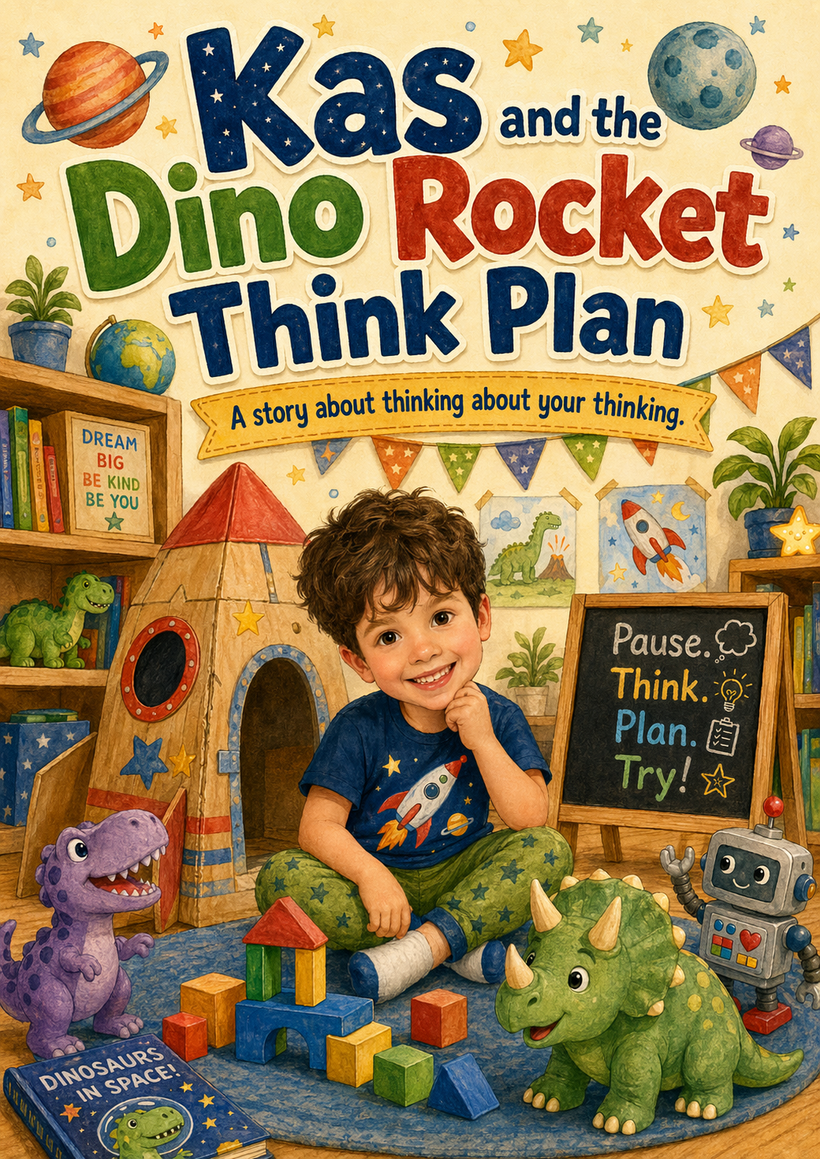
Given my verification of all the cited sources regarding "cognitive hygiene," I've been directing chatGPT on a series of illustrated books about cognitive hygiene for 5 year olds, together with teaching guides for each one and a curriculum for the series, including links to all sources. I have compiled 8 printable stories, a learning guide, and curriculum guide into a downloadable 60 mb zip file, and will work on making them available as print on demand at cost.