Art-Making and the life force (3)
Originally published for paying Patreon members on 2025-11-18. Republished here after a 90-day patron-first period.
Digging into the literature, it looks like there are studies of art-making in a wide variety of settings: dementia care, cancer care, depression and anxiety treatment. I don't know yet how comprehensive I want to be. I love a well-written literature review (when I taught college students, I referred them to Peter Kollock's lit review of social dilemmas.) But I'm inclined to riff on a few studies that ring my bell instead of boring both writer and reader with a comprehensive lit review.
Cancer patients, for example. 16 years ago, I was one.
(I chronicled that on good old Tumblr) (Which sparks the idea that maybe I ought to talk to the people who treated me about leading a watercolor fun class.)
In life-threatening scary diseases like cancer and Alzheimer's disease, there is the clinical progression of the disease and there is the way the patient reacts -- the mood, feelings, attitude. There is evidence that patient attitude can affect the clinical outcome of a treated disease, but I'm looking at a different goal for the same attempted remedy: enabling the patient (or caregiver) through art-making to connect with their life force and source of joy and find some good times amid the turmoil, anxiety, and pain. The problem isn't one of reacting to a diagnosis and treatment with grief, fear, and anxiety. I've been there. The problem comes when obsessive replaying of these natural reactions occludes the view of those moments of joy, beauty, tranquillity that occur even in the midst of catastrophe.
These thoughts have arisen from my personal encounter with cancer and my experience as a dementia caregiver. During my cancer treatment, I awoke every day with my mortality slapping me in the face. Every day at the infusion center, I saw people circling the drain. When I was declared cured, it was a rebirth into a life where the natural, widespread, denial of mortality had been burned away permanently. Every morning since then I have been slapped in the face with the glorious, miraculous, joyful possibility of another morning on earth. Life has had its ups and downs, but when people ask me how I am, my internal voice says "I don't have cancer!" I've thought about this shift in perspective -- as if a lens filter I had been looking through all my life was suddenly removed -- for the past 16 years. More recently, I encountered a truly wonderful book -- a gift to anyone who finds themself facing pain, mortality, grief -- that helped me crystallize my thoughts about finding joy amidst personal catastrophe.
The book is No Mud, No Lotus, by Thich Nhat Hanh. Mud is icky and smelly and lotuses are beautiful, and neither exists without the other. Hanh advocates breathing in and acknowledging one's suffering, then saying hello to it on the out breath. Sounds stupefyingly silly, but it does bring one back to the body and the moment. And recognizing the moments of beauty, love, happiness that occur, even fleetingly, even amidst pain and angst, instead of fixating on the very real suffering of the moment or fear of the future, has been transformative. My amateur opinion is that art-making can help in this sense because it brings one into the moment. Art-makers need to focus on the lump of clay or the brush on the canvas, sometimes with extreme attention, for prolonged periods.
Another aspect of brush-painting in particular is the metacognitive relationship between breath, eye, hand, brush, and paper, which I have written about here previously:
When one starts paying attention to attention, and using that attention to attention intentionally, the practice is called "metacognition" and has been shown to amplify learning. Painting is an attentional practice that, when done with awareness of this aspect of painting, is a metacognitive exercise.
To be exact, painting forces a continuous awareness, free of mind-wandering, to where the brush is at each present moment. At the same time, as one's painting practice deepens, the brush-awareness becomes finer: the pressure of the brush, the amount of paint on the brush at each moment, the position of the fingers, the way rotating the brush changes the line, the relationship between the figure the brush is painting and the ground that emerges from the negative space between brush strokes. For very fine and precise work, it is necessary to simultaneously coordinate the movements of hands, fingers, and eyes with the movement of the breath - painting smoothly on the outbreath for the finest lines. And attention to the breath appears to play a role in modulating consciousness.
Back to the research literature. All this philosophizing sounds good, but does it work in any measurable way? As far as I have discovered, all the trials are relatively small in the numbers of participants -- nothing like the thousands of people involved in clinical trials of pharmaceuticals. A meta-analysis of 39 studies published in Nature Mental Health involving adults above 55 without dementia who suffered from depression and/or anxiety, found that group arts interventions (painting, dance, music) were associated with moderate but statistically significant reductions in anxiety. The same meta-analysis found no significant difference between the positive effects of formal art therapy and less formal structured group arts activities, and noted that the social setting seemed significant -- art-making in a group was most effective.
Again, turning to my own experience, regular art-making with friends has been a part of my life since elementary school, when all the reprobates congregated in the liberated zone of my mother's art classroom. We called ourselves "the art club" and my activities making art on a weekly basis evolved into the Art Police in the 1980s, when we created large floats for Grateful Dead shows: Here's our Bill Clinton float:
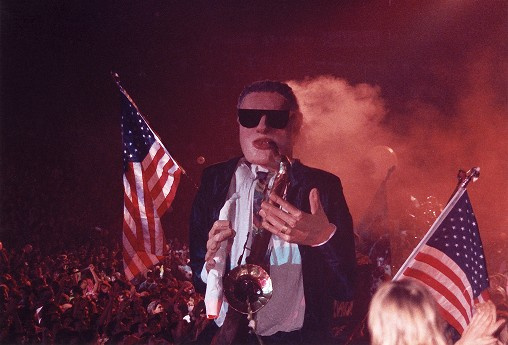
In the 2000s, the Mindshaft Society made large art for Burning Man; in the 2010s, the Pataphysical Studio was created from Mindshaft Society veterans specifically to make art together during my cancer treatment. The Pataphysical Slot Machine led to our current project, the Pataphysical Time Machine. We meet on Saturdays and we sometimes refer to it as "the art club." I wrote here at greater length about making art with friends.
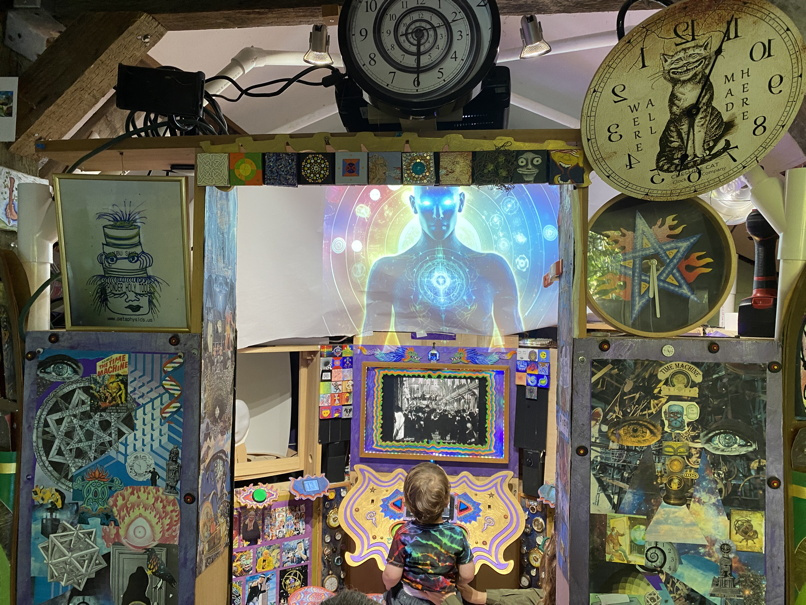
(Here is my grandson steering the Pataphysical Time Machine)
To be continued...